
7 Things to Check Before Ordering Custom 7v7 Uniforms
A successful custom uniform order starts with clear decisions. This guide expands all nine slides of Stagfield Sports’ Day 1 — Carousel 03 into a checklist for teams, clubs, academies and resellers preparing a 7v7 teamwear inquiry.
Start with a clear brief for your custom 7v7 uniforms
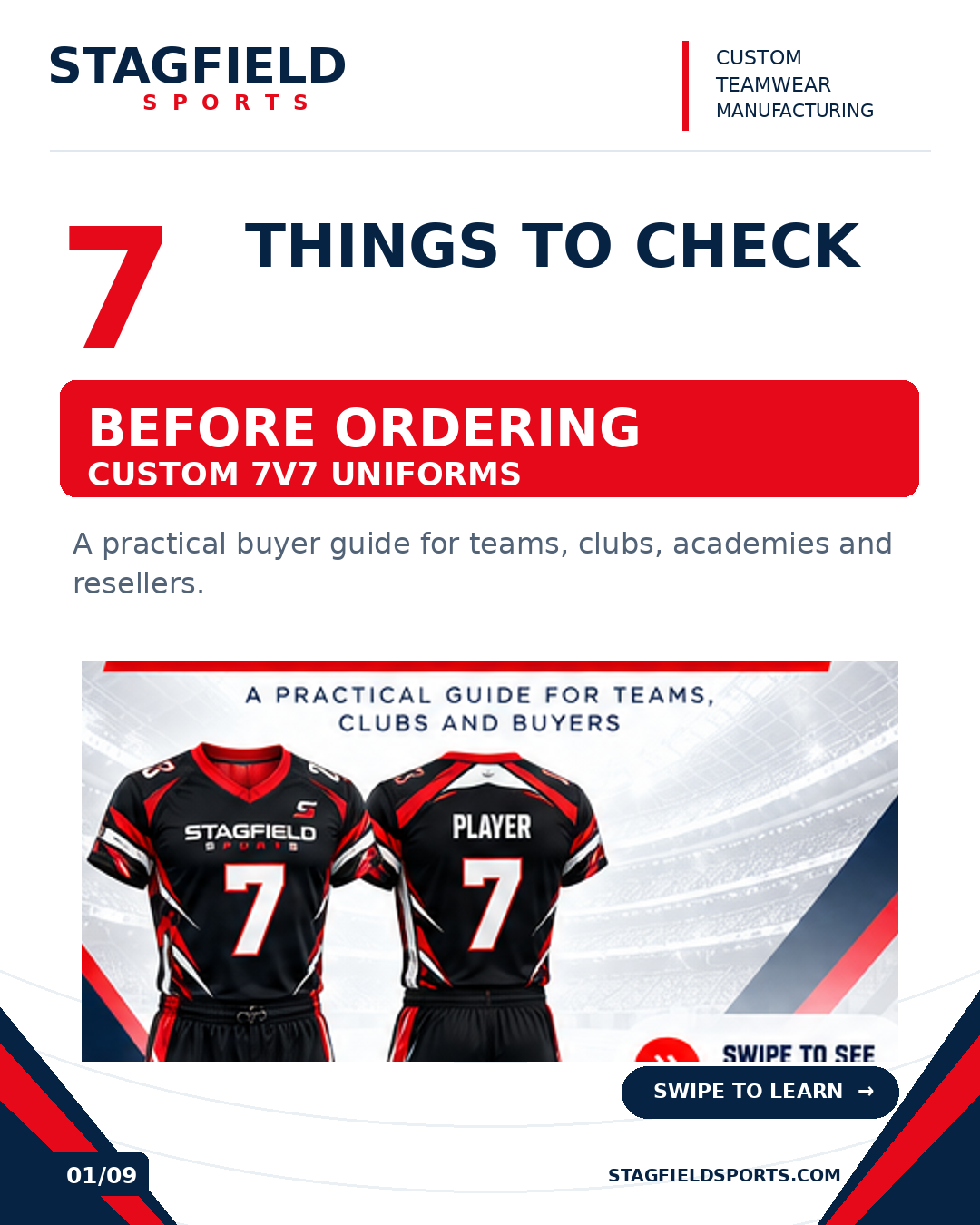
Ordering custom 7v7 uniforms involves more than choosing a design. Teams, clubs, academies and resellers need a shared understanding of what will be made, how it should fit and when it must arrive. A clear brief gives the buyer and supplier a reference for discussing the same product.
The seven checks below turn the original carousel into a practical buying guide. Use them to prepare questions for your supplier and record the answers before production. They are planning points to agree for your own order, rather than promises about a particular fabric, delivery date or manufacturing service.
1. Check fabric and performance against actual playing conditions
Begin with how and where the uniforms will be used. Explain the expected playing conditions and the team’s preferences for weight, feel and movement. Ask for the fabric composition and weight, then discuss breathability, stretch, recovery, durability and care requirements. A description such as “premium” does not tell you which material is being supplied.
A physical swatch, where available, gives you something tangible to review alongside the written specification. Check whether the proposed sample and bulk order will use the same agreed fabric. If alternatives are offered, record which one you selected rather than leaving the choice open.
Buyer action: request the fabric composition, a written material specification and a physical swatch when possible. Keep the approved reference with the order documents.
2. Confirm fit, measurements and the final size breakdown
Size labels alone are not a complete fit specification. Ask for the supplier’s size chart and clarify whether the figures describe body measurements or finished garments. Review jersey length, shoulder and chest measurements, and the intended fit. For orders covering both youth and adult players, confirm the relevant size ranges separately.
Discuss measurement tolerances so that everyone understands the acceptable variation from the agreed specification. Where practical, review a physical size sample with the people responsible for choosing the team’s fit. Use that review to resolve questions before finalizing the roster.
Buyer action: approve at least one physical size sample where practical, then confirm the quantity required in each size. Give the final size breakdown a date or version so an older roster cannot be mistaken for the production instruction.
3. Specify shorts and construction details
Review how the uniform is constructed as well as how it looks. For shorts, confirm the waistband style, drawcord, inseam and allowance for movement. Discuss side panels and seam reinforcement, and make sure the construction details shown in the design are understood by the supplier.
Confirm whether pockets are required or excluded. Check the rules of the specific league or event before approving this detail; the carousel does not establish a universal rule for every competition. Put the resulting requirement into the order specification.
Buyer action: record the agreed construction details in a tech pack or written product specification. Use annotated drawings or sample references where words alone could be interpreted differently.
4. Make customization instructions precise
Prepare the complete artwork package before approving the uniform design. Supply high-resolution or vector logos, team color references, player names and numbers, font choices and sponsor placement. Include both front and back artwork so no part of the design depends on an assumption.
Treat the player list as a production document. Check spelling, number assignments and the relationship between each player and their chosen size. If the same information appears in several files, choose one final reference and make sure the supplier knows which version controls the order.
Buyer action: approve the artwork, placement and color references in writing. If a detail changes, issue a revised proof and identify which previous version it replaces.
5. Review samples and artwork before the bulk order
Use the approval stage to resolve questions before the bulk order proceeds. Depending on what has been agreed, review a pre-production sample, artwork proof or both. Check fit, materials, printing, stitching, logo placement and color against the written brief. Discuss wash performance where relevant and agree how it will be assessed.
Match each approval to what it can actually demonstrate. An artwork proof can show the proposed layout and spelling, but it cannot establish the feel of a fabric or the fit of a finished garment. Record any features that still need a physical sample or another agreed check.
Buyer action: keep a final reference sample or signed specification. List corrections clearly and confirm their resolution before giving final approval for bulk production.
6. Reconcile quantities, personalization and packaging
Confirm the minimum order quantity and reconcile the total order with the quantities in each size. Clarify what counts as a set or an individual piece, and check that the player list matches the garments being ordered. Include any spare units in the same final order sheet.
Agree the packaging requirements before production. These may include labels, individual bags, carton marks or retail-ready packaging. Explain how you intend to receive and distribute the uniforms so that the supplier can quote and confirm the requested packing arrangement.
Buyer action: use one final order sheet with version control. It should connect quantities, sizes, player details and packaging instructions without requiring the supplier to combine conflicting messages.
7. Agree the timeline and quality checks
Work back from the date the team needs the uniforms. Agree sample dates, time for adjustments, production lead time and shipment assumptions. Distinguish the planned dispatch date from the required delivery date, and clarify when the production timeline begins—for example, after the agreed approvals are complete.
Specify inspection checkpoints and how defects or quantity discrepancies will be reported and handled. Record who will review the order and what reference documents they will use. These discussions help turn a general expectation of quality into an agreed checking process.
Buyer action: build time into the plan for sample adjustments and shipping. Get the schedule and inspection arrangements confirmed for the actual order rather than assuming a standard turnaround applies.
Bring the seven checks together in your inquiry
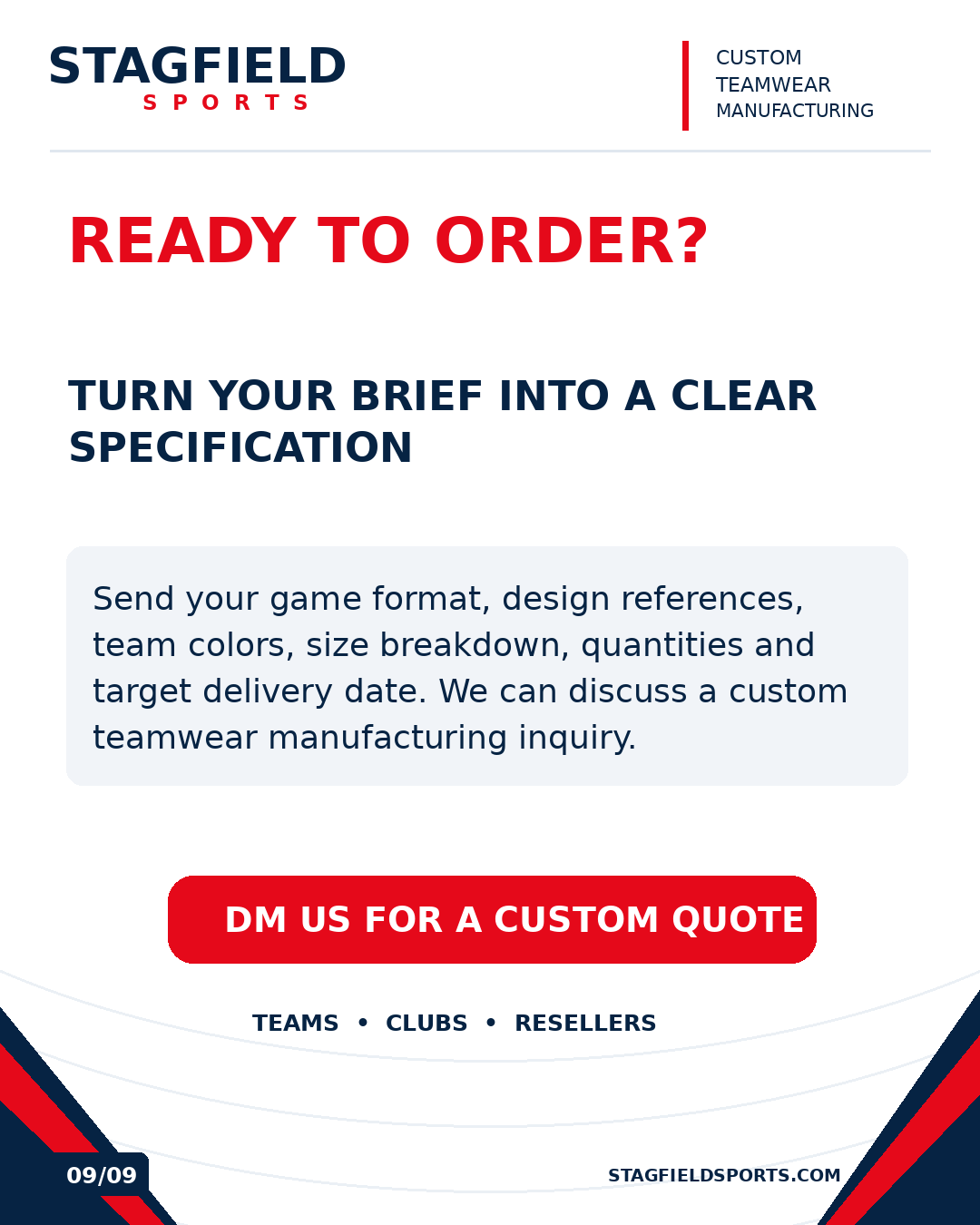
Before requesting a quote, gather your game format, design references, team colors, size breakdown, quantities and target delivery date. Add any specific fabric, construction, personalization and packaging requirements you have already identified. Mark undecided items as questions so they can be resolved explicitly.
A useful final check is to ask whether someone could understand the order from the approved documents alone. If the answer depends on an old message, an unconfirmed image or a verbal assumption, bring that detail into the written brief. Keep the final artwork, roster, specification and approval records together.
To discuss your requirements with Stagfield Sports, use the website’s request-a-quote form. Share the brief and explain which decisions you need help clarifying. A quote and production plan should be based on the details agreed for your team, club, academy or resale order.